Our Blog

Losing a Baby Tooth

March 27th, 2019
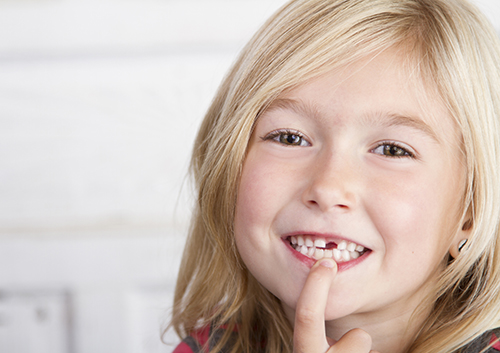
It seems like yesterday. There you were, comforting your baby through sleepless nights, soothing her with a dentist-approved teether, celebrating as that first tiny tooth poked through her gums. And now here she is running to show you that same tooth, wiggly, loose, and almost ready for the Tooth Fairy. Now what?

Be Prepared

Children normally lose that first tooth somewhere around the age of six, but a year or two earlier or later is not uncommon. If you ever took a business class, you might have heard of the inventory method called “First In, First Out.” Baby teeth operate much the same way! The two bottom front teeth, followed by the two upper front teeth, will probably be the first teeth your child loses. Once you notice some wiggling, let your child know what is going on and reassure her that it is a normal part of growing up.

What to Expect with that First Loose Tooth

Normally, baby teeth become loose when the pressure from the permanent tooth below gradually breaks down the roots of the primary tooth. If your child has a loose tooth, encourage him to wiggle, not pull. Typically, gentle wiggling is all that is needed to free a tooth that has lost most of its root and is ready to be replaced. Avoid pulling or forcing the tooth, because that can cause injury to the root area if the baby tooth isn’t ready to come out. Call our Plaistow, New Hampshire office if you have any questions about loose teeth. Melissa Newman and our team also have suggestions if the baby teeth don’t become loose on schedule, or if they stubbornly remain in place even after the adult teeth have started to show up. One important note—if your child ever loses a tooth through accident or injury, call us at once. We might need to provide a spacer to give your child’s permanent teeth the proper time and space to come in.

Celebrate this Milestone with Your Child

The arrival of the Tooth Fairy is a familiar way to mark the occasion, and she can leave your child a note, a small gift, even a brand new toothbrush. Or explore other options!

If your child is fascinated by stories and traditions, learn about El Ratón Pérez (Perez the Mouse), a familiar tooth-collector in many Spanish speaking countries, or his French cousin, La Petite Souris (the Little Mouse). In other parts of Europe, Asia and Africa, children throw teeth on the roof, drop them in a glass of water, or hide them in a slipper. This is a great opportunity for you and your child to explore the world!

If your child likes science, look into books that explain the biology of baby and adult teeth in an age-appropriate way. You could print a chart of the primary teeth and take notes on each lost tooth as it makes way for the permanent tooth below. Or track her progress with photos showing the baby tooth, the gap left by the tooth, and the adult tooth as it comes in.

Losing that first tooth is an important moment for your child—and for you. Be prepared to celebrate another milestone together, and always feel free to talk to Melissa Newman if you have any questions about this new stage in your child’s life.


Teeth Grinding Can Damage Your Teeth

March 20th, 2019

Grinding of the teeth, also known as bruxism, is a serious condition from which nearly ten percent of Americans suffer. It’s a mechanical reflex that often happens during slumber. Unfortunately, most people don’t recall grinding their teeth when they awaken.

This makes it difficult to catch the condition before serious damage occurs. Some people notice soreness in their jaw, shoulder and neck pain, or even headaches. Others aren’t so lucky and don’t feel any pain until a professional notices they have developed cracked teeth, receding gums, and jaw problems.

Melissa Newman and our team hope to prevent teeth grinding before serious health concerns arise. Let’s go over the reasons for grinding as well as preventive tips to help you feel better fast.

Why do you grind your teeth?

The most common reasons for teeth grinding include:

  • Stress
  • Anxiety
  • Aggression
  • Poor muscle control
  • Acid reflux
  • Sleep apnea
  • Complications from certain disorders

It’s worthwhile to understand the reason you’re grinding your teeth, but it’s even more vital to treat the issue quickly. You can take measures to alleviate the pain you may be experiencing, such as applying a warm wash cloth to your jaw, taking muscle relaxants, massaging the jaw muscles, visiting a chiropractor, or doing physical therapy.

Prevention

To protect your oral health and jaw bones, try these preventive measures:

  • Reduce the amount of stress in your life
  • Drink plenty of water every day
  • Avoid chewing gum or chewy foods
  • Get plenty of sleep each night
  • Reduce or stop alcohol and caffeine consumption
  • Get a custom mouthguard from Highland Family Dental

Melissa Newman and our team want to make sure you’re properly treating your teeth grinding issues. Feel free to call our Plaistow, New Hampshire office if you think you may be suffering from this condition, or have questions regarding a treatment plan.

Teeth grinding can lead to far more serious health issues, and should be ended before it becomes a major concern.

St. Patrick's Day

March 13th, 2019

On March 17, everyone has a little Irish in them. St. Patrick’s Day is a joyous celebration of Irish heritage. The holiday originated as a commemoration of Saint Patrick, who brought Christianity to Ireland. The saint arrived in Ireland in 432 and earned the reputation of a champion of Irish Christianity. March 17th, the day of St. Patrick’s death, has been commemorated by the Irish for over 1,000 years. St. Patrick’s Day is still observed as a religious feast day by several Christian denominations, but it is better known in the public imagination as a rich celebration of Irish culture.

St. Patrick’s Day has been an official public holiday in Ireland since 1903. Each year, the Irish celebrate with a several-day festival that includes theater performances, music, fireworks, and festive parades. The celebration is also a public holiday in Northern Ireland, Montserrat, and Newfoundland and Labrador. In other parts of the world with heavy Irish populations, it is an unofficial celebration of Irish heritage. Parts of Great Britain, Canada, Argentina, South Korea, Switzerland, New Zealand, the United States, and Australia commemorate the holiday each year. Typical celebrations in these countries include drinking green beer, wearing green, eating traditional Irish foods, parades, and shamrock decorations.

Many people, Irish and non-Irish alike, take part in the “wearing of the green” on St. Patrick’s Day. In fact, the color originally associated with Saint Patrick was blue. His use of shamrocks to explain the Holy Trinity to the Irish made the green clover emblematic of the holiday, leading to the traditional green attire worn by thousands on St. Patrick’s Day. Other little-known facts about St. Patrick’s Day include the following:

  • Each year, the United States and Ireland face off in a rugby competition called the “St. Patrick’s Day Test.”
  • Montreal celebrates the holiday with an annual parade, which has been held each year since 1824. The Montreal city flag even features a shamrock in its corner, as a nod to its Irish heritage.
  • The Guinness World Records named St. Patrick’s Day the “Friendliest Day of the Year.”
  • Along with Valentine’s Day, St. Patrick’s Day is one of the most widely celebrated saint’s day in the world.

No matter your cultural heritage, St. Patrick’s Day is a great time to let loose and celebrate your inner Irish-ness! Don your greenest attire and exclaim “Erin go Bragh!” (Ireland forever!) to everyone you meet. From Melissa Newman - have a great St. Paddy’s day!

March is National Nutrition Month!

March 6th, 2019

While you don’t have to wait to start eating right, March is the month the Academy of Nutrition and Dietetics asks everyone to pay special attention to what goes into our bodies. The Academy has designated the month of March for focusing the public’s awareness on what they eat.

What Not to Eat

The academy points out that the foods you eat have a direct effect on the health of your teeth and specifically on tooth decay. Bacteria rely on carbohydrates to thrive. That is why Melissa Newman and our team at Highland Family Dental tell our patients to cut back on both candy and sweets. They consist of simple sugars that feed the bacteria in your mouth and enhance tooth decay.

It’s the hidden sugars that will cost you, though. Get in the habit of reading labels on food and looking for products with added sugar. This includes ingredients that end with the suffix “ose.” When it comes to nutrition, these foods offer little value beyond satisfying that sweet tooth.

What You Should Eat

Turn to foods that not only taste good but are good for your teeth too. Dairy products, for example, provide the body with nutritional items that support tooth enamel. Foods high in protein feature phosphorus, a nutrient critical to oral health.

You can’t really go wrong by adding color to your diet, either. Fruits and vegetables make for a colorful plate and a healthy meal. Use some caution with acidic fruits like oranges or even tomatoes, because the acid can erode tooth enamel. It is better to include these foods in a meal instead of eating them by themselves.

Remember, good nutrition is something you should worry about all year long, not just when celebrating National Nutrition Month. March just serves as a fun reminder that eating right is a proactive step in managing your dental health.

We encourage you to give us a call at our Plaistow, New Hampshire office to learn more!

(603) 382-6976
166 Plaistow Rd, Unit G 1
Plaistow, NH 03865
Mon8:00am to 5:00pm
Tue8:00am to 5:00pm
Wed8:00am to 5:00pm
Thu7:00am to 3:00pm
FriClosed
SatClosed
highland family dental